Can't put your phone down? Stanford psychiatrist Dr Anna Lembke's 4-week reset
How to stop phone addiction: Stanford psychiatrist Dr Anna Lembke tells The Diary Of A CEO to track honestly, add barriers and take a four-week break.
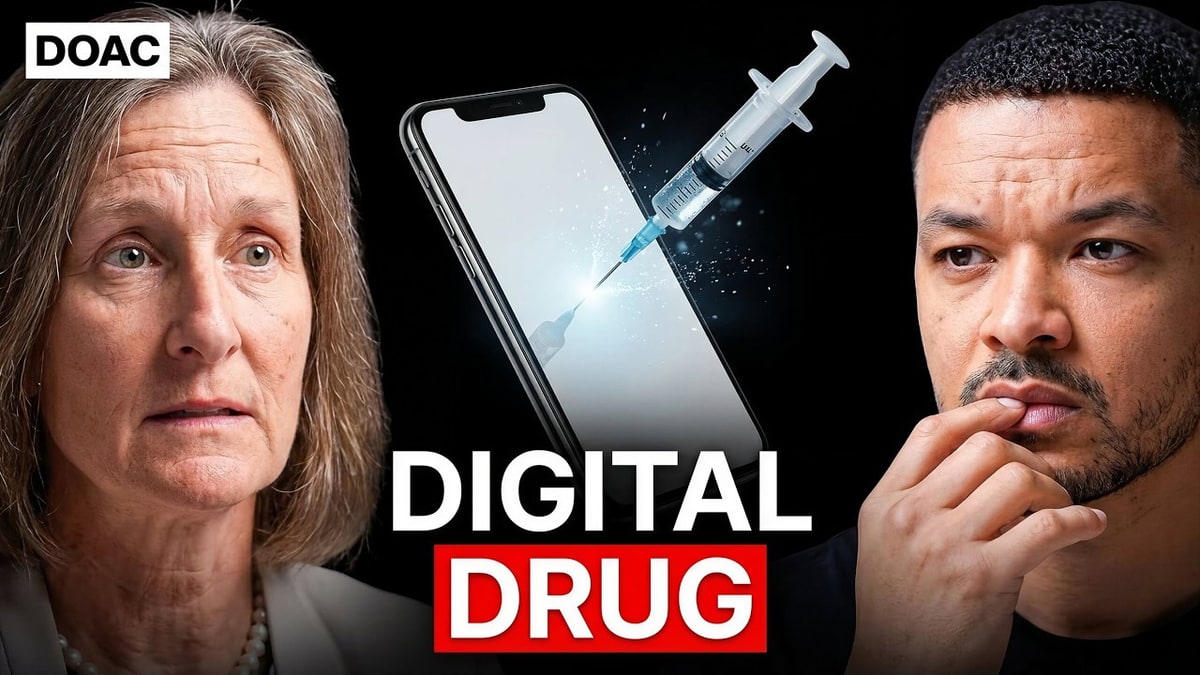

If your phone keeps winning the fight for your attention, start by counting honestly and then take four weeks off your worst app. That is the core advice of Dr Anna Lembke, professor of psychiatry and medical director of addiction medicine at Stanford University, on The Diary Of A CEO with Steven Bartlett. The video above plays only the part on breaking the habit.
The short version
- Find your “drug of choice”. For many people it is one app or one kind of video, not the whole phone.
- Count backwards honestly. Lembke suggests going back through the last seven days and adding up your real use.
- Expect to underestimate. She says we are “very bad self observers”.
- Take a four-week break from that one thing. About four weeks is how long it takes, on average, to get past the worst of withdrawal.
- The first 10 to 14 days are the hardest: restlessness, irritability, poor sleep, low mood and cravings are normal.
- Use barriers, not willpower. Phone out of the bedroom, app deleted.
What does Dr Anna Lembke say about phones?
Lembke’s frame is what she calls the pleasure-pain balance. Constant easy rewards push the brain to compensate, so over time you need more to feel normal and ordinary life feels flat. Her answer for any compulsive habit, from sugar to scrolling, is a reset: stay away from it long enough for your brain to recalibrate.
She tells a story against herself. After long clinic days she had started watching YouTube to relax, and thought it was half an hour a couple of times a week. When her teenage daughter said she was always on YouTube now, Lembke tracked it and found it was one and a half to two hours a day, around 14 hours a week. The videos? Dr Pimple Popper, which she admits was embarrassing.
That is why she starts with data. Pick the behaviour that costs you time you would rather spend on people or meaningful work, then use what she calls the timeline followback method: start today and count back through each day of the past week.
What happens in the first weeks without it?
Lembke recommends at least four weeks, because that is roughly how long it takes to come out of acute withdrawal and enjoy smaller rewards again without constant craving. The first 10 to 14 days are the worst, and patients often feel the craving will never end. She reassures them that it fades if they can wait it out.
Willpower, she says, is an exhaustible resource. So she prefers self-binding: putting a physical barrier between you and the habit, such as getting the phone out of the bedroom or deleting the app. After the four weeks, some people stay off it and others go back to smaller amounts. Cutting down is worthwhile even if you do not quit completely, and she warns against all-or-nothing thinking that turns one slip into shame.
Our take
There is good support for the basic idea that less phone means better attention. In a 2025 randomised experiment published in PNAS Nexus, people who blocked mobile internet on their phones for two weeks, while keeping calls and texts, improved on a sustained attention test and reported better well-being. The ‘dopamine’ framing is a simplification of brain science, but the practical advice holds up.
For Pakistani students, a total phone fast is not realistic when class groups, notes and family coordination all run on WhatsApp. Lembke’s approach fits better: pick the one thing that eats your evening, often short videos, and remove only that for four weeks, especially in the run-up to board exams, MDCAT or CSS. If you share a room in a joint family, keep the phone charging in the lounge at night instead.
This is about screens. If your habit involves alcohol or pills, do not stop suddenly on your own; Lembke notes that withdrawal can be dangerous, so talk to a doctor first.
Try this today
- Open your screen-time settings and write down last week’s total for your top app.
- Delete that app, or log out of it, for the next 28 days.
- Charge your phone outside the bedroom tonight.
- Mark day 14 on your calendar. That is when Lembke says it usually gets easier.
This article is for general information and is not medical advice.
Other parts of the episode
Sources
- The Diary Of A CEO: Dopamine Expert Dr Anna Lembke (YouTube, January 2026)
- The Singju Post: Diary Of A CEO with Dr. Anna Lembke on Dopamine Addiction (transcript)
- The Diary Of A CEO: independent research and further reading for the Anna Lembke episode
- PsyPost: Blocking mobile internet for two weeks improves focus and well-being (PNAS Nexus study)
This story was researched and drafted with AI assistance, then checked and edited by our editor before publishing.