Scattered focus and ADHD: why Dr K says build one tiny habit for 66 days
How to focus with ADHD: psychiatrist Dr Alok Kanojia (Dr K) says habits run on autopilot, so build one small habit at a time and plan for what will go wrong.
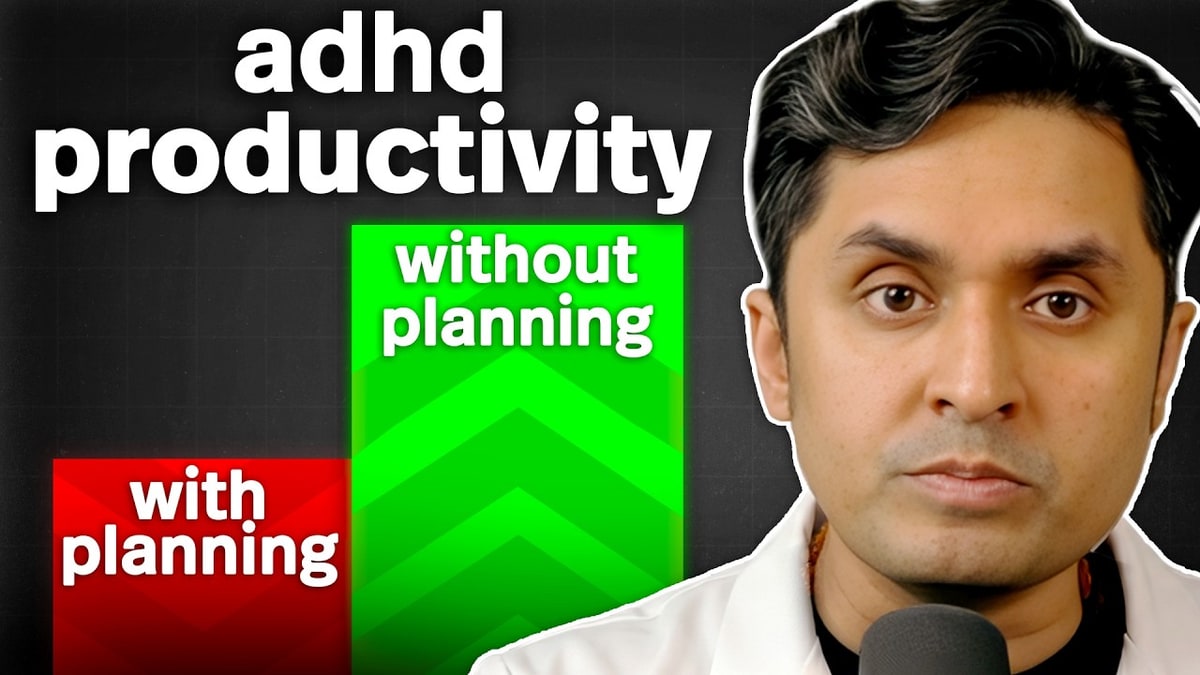

If your attention scatters and every new routine collapses after a week, psychiatrist Dr Alok Kanojia, known online as Dr K of HealthyGamerGG, says the fix is not a bigger plan. It is one tiny habit, tied to a daily transition, kept up for about 66 days. His 15-minute video is above in full.
The short version
- Habits run on autopilot, so they keep working even when your attention drifts. That makes them powerful for ADHD.
- The usual reward-based advice often fails ADHD brains, because boring tasks give too little reward.
- Forget 21 days. Dr K cites research where habits took 18 to 254 days, with a median of about 66.
- Build one habit at a time, and make it very small.
- Anchor it to a transition, like arriving home or switching tasks, when ADHD time tends to leak away.
- Plan for obstacles, not for perfection.
What does Dr K say about focus and habits with ADHD?
Dr K starts with an irony: good habits protect people with ADHD from many of their daily problems, yet ADHD makes consistency hard. He explains that ADHD involves weaker planning and impulse control in the frontal lobes and an altered dopamine reward system. New things give a quick spike that fades fast, and dull tasks give almost nothing.
But, he says, the brain’s habit circuitry is a separate system that stays relatively intact in ADHD. That is the system to train. Once something is a habit, it no longer needs your attention, which is exactly what a distracted brain needs.
He is critical of standard cue-craving-reward frameworks like the one popularised by Atomic Habits. With ADHD, cues get filtered out, cravings depend on dopamine, and finishing a task feels like a weak reward. So his steps are different.
First, accept that habits take time and ignore the urge to see quick results. Second, choose one very small habit. His example is always putting your keys in one fixed spot and never setting them down anywhere else, because lost keys cause his patients a surprising amount of stress. Third, focus on transitions and set up your environment, such as a basket by the door. Fourth, reduce friction and work out in advance what is most likely to derail you. He says building complex plans is not what leads to good results with ADHD.
His “big secret” is that doing this repeatedly teaches you the skill of building habits, so each new one gets easier.
Our take
The 66-day figure comes from a well-known 2009 University College London study of habit formation, which found a wide range between people. Planning for obstacles also has solid support in behaviour-change research. The neuroscience is simplified, as it has to be in a short video, but the advice is sensible and low-risk.
This works whether or not you have a diagnosis. Many Pakistani students and young professionals describe “ADHD-like” scatter that is really poor sleep, phone overload or stress. If focus problems have been there since childhood and affect school, work and relationships, an assessment by a psychiatrist is worth it. ADHD in adults is under-recognised here.
For exam season, pick one habit, not a timetable of ten. “Phone goes in the drawer when I sit at the study table” is a good first one. In a busy joint-family home, “bag and keys go on the same shelf every time I come in” can save more time than any productivity app.
Try this today
- Choose one problem that keeps repeating, such as lost keys, a missed charger or a phone at the study table.
- Turn it into one tiny action tied to a moment: “When I walk in the door, keys go in the basket.”
- Write down the one thing most likely to break it, and your plan for that moment.
- Mark 66 days on your calendar and do not add a second habit before then.
This article is for general information and is not medical advice.
Key moments in the video
Sources
This story was researched and drafted with AI assistance, then checked and edited by our editor before publishing.