How to improve focus: 7 free tools from Andrew Huberman on Huberman Lab Essentials
Struggling to concentrate? Andrew Huberman's Huberman Lab Essentials episode explains the brain chemistry of focus and simple tools you can try today.
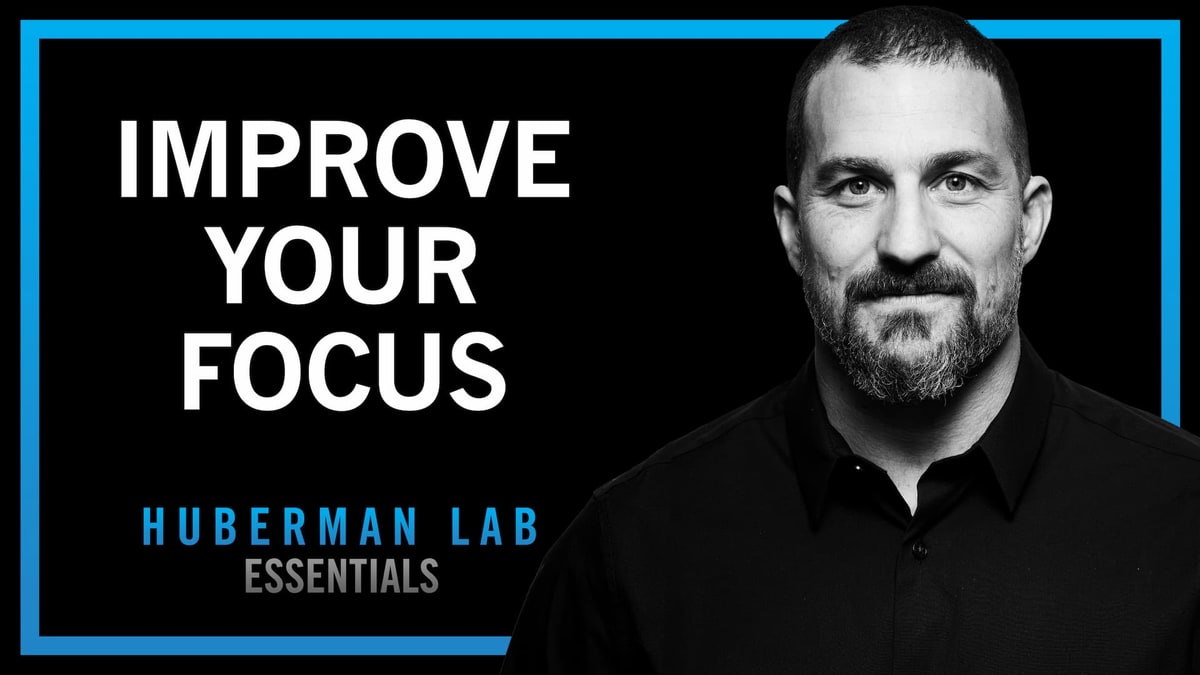

Huberman Lab Essentials: Tools to Improve Your Focus & Concentration is a 37-minute episode in which Stanford neuroscientist Andrew Huberman explains what is happening in the brain when we focus, and which mostly free habits help. If you are studying for exams, working long shifts or just losing the battle with your phone, it is one of his most practical episodes.
Essentials episodes are shorter cuts of his longer shows, and this one condenses his 2022 Focus Toolkit episode. The details below come from the episode’s official chapter list and the official Huberman Lab notes for the original.
Key takeaways
- Huberman describes focus as an arrow: adrenaline (epinephrine) is the shaft, acetylcholine the sharp tip that picks the target, and dopamine the motivation that keeps it going.
- Sleep comes first. He says no focus tool makes up for regularly sleeping badly.
- The first 5 to 10 minutes of any work session are a warm-up, so expect to feel scattered at the start.
- Work in blocks of about 90 minutes or less, then deliberately switch off.
- A 13-minute daily meditation trains you to bring attention back when it drifts.
- Staring at one point for 30 seconds or more can act as a quick warm-up before work.
- Supplements and ADHD medicines are discussed, but he ranks behaviour, food and sleep ahead of them.
What the episode covers
- 0:00 What focus and concentration are.
- 2:00 The three brain chemicals behind focus.
- 4:20 Sleep, white noise and pink noise.
- 7:35 90-minute work sessions.
- 9:15 Blood sugar, fasting and meal size.
- 12:10 Caffeine, focus and sleep.
- 13:25 Why a little stress can sharpen concentration.
- 15:25 Deliberate cold exposure.
- 18:10 The 13-minute daily meditation.
- 22:20 Visual focus exercises.
- 27:00 Omega-3s, creatine and other supplements.
- 32:55 ADHD, prescription medicines and neuroplasticity.
- 35:50 Why switching off helps you focus later.
The 13-minute meditation
Huberman’s version is simple: sit, breathe through your nose, and rest your attention on a spot just behind your forehead. Each time your mind wanders, bring it back. He stresses that drifting is not failure; the return is the exercise. He bases it on a study from neuroscientist Wendy Suzuki’s lab, published in Behavioural Brain Research, which found that eight weeks of brief daily meditation improved attention, memory and mood in people new to meditation. It was a small study, so treat it as promising rather than settled. He advises not doing it within about four hours of bedtime.
Visual focus: train your eyes, train your mind
Pick one spot, on a wall or a screen, and keep your gaze there for 30 seconds. Blinking is fine. Add a few seconds each day, up to about three minutes. Huberman suggests using it as a warm-up before study or exercise, and as a reset when your attention slips, instead of reaching for your phone.
Work blocks and switching off
He recommends focused sessions of up to about 90 minutes, starting with one a day, followed by 10 to 30 minutes of low-effort activity like walking without your phone. In his view, giving the brain real downtime is what makes the next session work.
Caffeine and food
Huberman suggests a moderate dose of caffeine and, in his own routine, waiting 90 to 120 minutes after waking before the first cup, and stopping 8 to 12 hours before bed. The delay idea is popular but the evidence for it is limited. Big meals make most people sleepy, so he prefers lighter meals before focused work.
About supplements and medicines
The episode discusses omega-3s, creatine and others, and notes a study in JAMA Network Open linking long-term use of one supplement, alpha-GPC, to higher stroke risk. Prescription ADHD medicines can help people who are diagnosed, he says, but he strongly warns against using them without a prescription. Do not start, stop or change any supplement or medicine based on a podcast; speak to a doctor first.
This summary is not medical advice.
Try this today
- Before your next study or work session, stare at one point for 30 seconds.
- Set a timer for 60 to 90 minutes and keep your phone in another room.
- When the timer goes off, take a 10-minute walk without your phone.
- Tomorrow morning, try 13 minutes of the breathing meditation and see how your day compares.
Sources
- Huberman Lab: Essentials: Tools to Improve Your Focus & Concentration (episode page)
- Huberman Lab: Focus Toolkit: Tools to Improve Your Focus & Concentration (original episode notes)
- Behavioural Brain Research (PubMed): Brief, daily meditation enhances attention, memory, mood, and emotional regulation in non-experienced meditators
- JAMA Network Open (PubMed): Association of L-α glycerylphosphorylcholine with subsequent stroke risk after 10 years
This story was researched and drafted with AI assistance, then checked and edited by our editor before publishing.